 |
PROCUREMENT
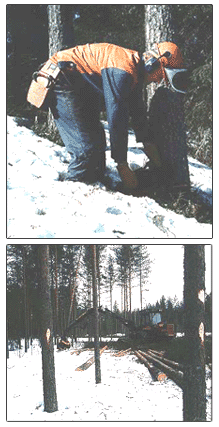
Although the stands of Pinus Sylvestris in Finland are homogeneous,
the experienced professionals of IVO Power Engineering Ltd ensure
that only the stems most suitable for po]es are selected prior
to felling, whether the trees are felled manually or using the
most modem harvesting technology.
Since the poles are felled during the winter season, and debarked
and transported rapidly to well-organised storages, the quality
of poles is secured. The rawpoles are handled with care during
the preliminary seasoning and loading on ships heading frequently
for Turkey according to the needs of Unipole.
Wooden poles have been procured in Finland for more than 100
years together with the harvesting of other forest products.
As the forest sector is based on sustained yield, our clients
can rely on the fact that wooden poles are always available
in Finland, which is not the case with countries producing poles
from raw materia] grown on man-llade plantations of imported
species. In such countries harvesting could be suddenly banned
for environmental reasons.
PINUS SYLVESTRIS OF FINNISH ORIGIN
Pinus Sylvestris is commonly called by then following names;
Redwood, Baltic Redwood, European Redwood, Scots Pine or Scotch
Fir. The terminology can be confusing as the redwoods in America
and Asia are of collpletely different species and of Sequoia-related
fallilies, which are often not the best raw materia] for utility
poles. Another common confusing name is Red Pine, which is in
fact a North American Pinus Resinosa.
The conditions of growth are important for producing satisfactory
material for poles, which must be strong, straight and free
troll ]arge or dead knots or other defects. The climatic conditions
in Finland, between the 60th latitude and the Arctic Circle
are ideal, providing the trees with close annual rings, straight
stem, thin branches and an optimal amount of sapwood.
As the summers in Finland are short and the severe winters are
long, the poles are free from hazardous insects and diseases,
which is a fact to be taken into account overseas.
As Pinus Sylvestris has good permeability, the whole of the
sapwood is penetrated by the selected preservative and the heartwood
itself is resistant to fungi due to the pinosylvines which accumulate
while the tree is growing. Neither steam conditioning nor incising
are needed to ensure satisfactory penetration. These measures,
which are necessary for some species, may even weaken the strength
properties of utility poles.
Homogeneity is one of the advantages of the Finnish Pinus Sylvestris.
Due to this factor, the designer of an overhead line can rely
on the fact that the calculations tally with the reality, and
that oversized safety factors are not needed..
|